


Raw hair is the most valuable hair on the market—and that’s exactly why so much of what’s sold as “raw” isn’t. If you’re a stylist, a reseller, or a shop owner sourcing in bulk, the difference between genuine raw hair and a clever imitation is the difference between happy repeat customers and a pile of returns three washes later. The problem is that fake raw hair looks convincing in a photo. It only reveals itself in your hands.
The good news: you don’t need a lab. There are four hands-on tests—the eye test, the touch test, the bleach test, and the cuticle scrape—that any buyer can run to confirm whether hair is real raw hair before committing to an order. This guide walks through each one in the exact order a factory would use them, so you can separate a trustworthy hair vendor from one hoping you won’t check.
First, What “Raw Hair” Actually Means
Before you can test for raw hair, you need to know what you’re testing for. Raw hair is human hair cut directly from donors that has never been chemically processed—no perming, no coloring, no acid baths. The cuticle (the outer protective layer of each strand) is fully intact and, crucially, all the strands run in the same direction, from root to tip. That alignment is why real raw hair resists tangling and lasts for years. The highest form of it is graded as raw single donor hair—cut hair, single-donor sourced, completely unprocessed—and that’s the standard the tests in this guide are really checking for.
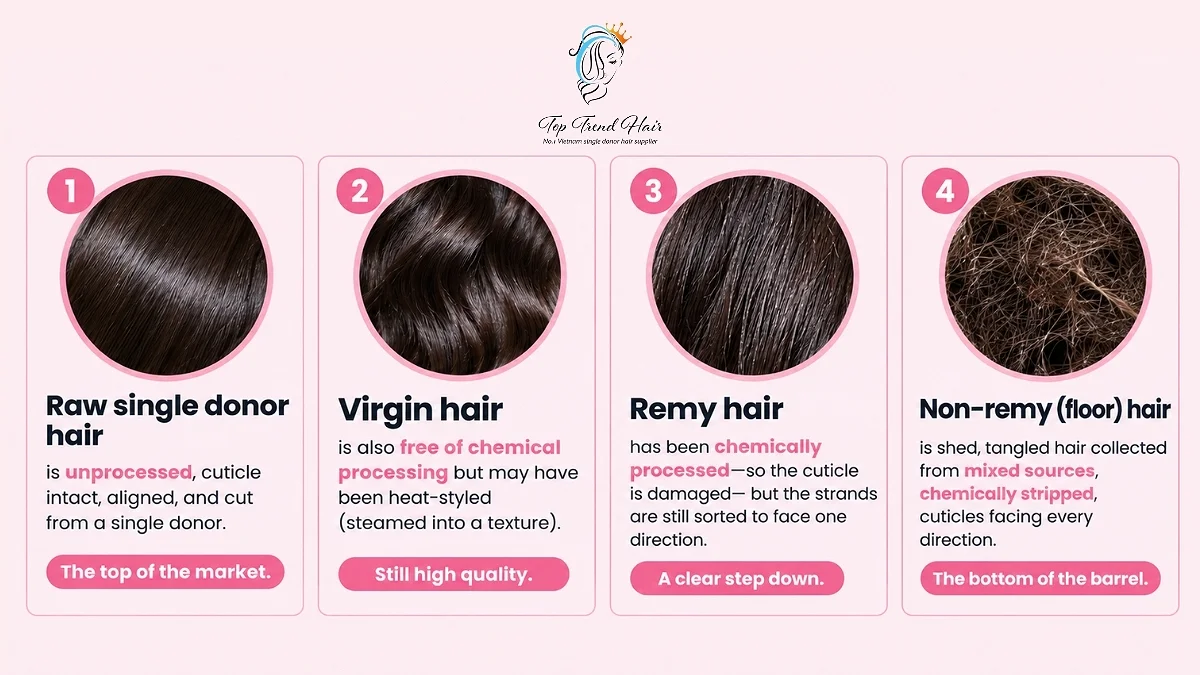
It helps to know where raw sits against the other grades you’ll hear vendors throw around:
- Raw single donor hair is unprocessed, cuticle intact, aligned, and cut from a single donor. The top of the market.
- Virgin hair is also free of chemical processing but may have been heat-styled (steamed into a texture). Still high quality.
- Remy hair has been chemically processed—so the cuticle is damaged—but the strands are still sorted to face one direction. A clear step down.
- Non-remy (floor) hair is shed, tangled hair collected from mixed sources, chemically stripped, cuticles facing every direction. The bottom of the barrel.
Here’s why the fakes exist: genuine raw hair, especially cut hair, gets rarer and pricier every year. To keep prices down, some workshops quietly blend cheaper floor hair into a raw bundle, or coat processed hair in silicone so it feels soft in the shop. It passes the first glance. It does not pass the tests below. A common warning sign a vendor is selling you a blend: hair that sheds and tangles after a few washes, or “raw” hair that either won’t bleach to a clean blonde—or bleaches but comes out frizzy and brittle.
Test 1: The Eye Test (Your First Filter)
Start with what you can see, because it costs nothing and rules out the obvious fakes fast.
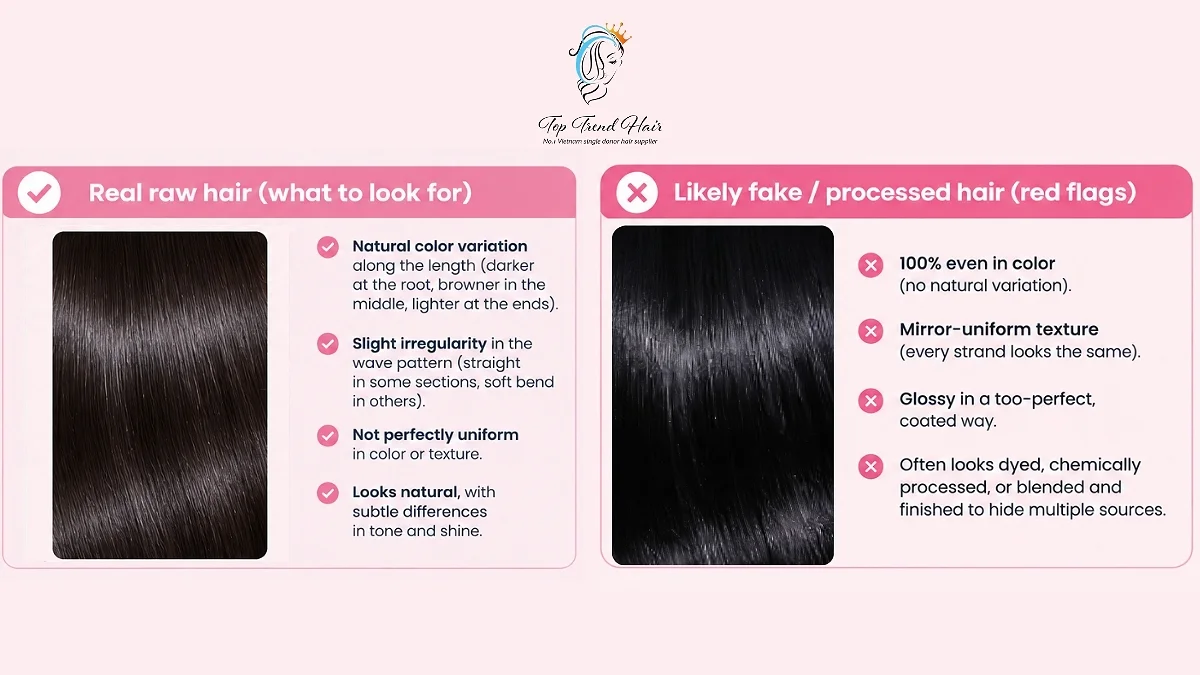
Real raw hair is not perfectly uniform, and that imperfection is the point. Because it comes from a real person’s head, the color varies naturally along its length. Vietnamese raw hair, for example, typically shows three subtle layers: a darker black near the root, a browner tone through the middle, and lighter, sun-touched ends. Hair that’s spent years in the sun shifts to a natural brown at the tips. You’ll also see slight irregularity in the wave pattern—straight in some sections, with a soft bend in others.
Now flip it: if a bundle is 100% even in color, mirror-uniform in texture, and glossy in that too-perfect, coated way, be suspicious. That level of consistency usually means the hair has been dyed to match, chemically processed, or blended and finished to hide multiple sources. Nature isn’t that tidy.
The eye test won’t confirm raw on its own—a skilled workshop can fake appearance—but it’s an excellent way to eliminate the worst offenders before you spend another minute.
Test 2: The Touch Test (Don’t Skip This One)
This is where a lot of buyers get fooled, because “soft” feels like “quality.” With raw hair, it’s the opposite.
Genuine raw single donor hair feels slightly dry, matte, and natural to the touch—there’s a faint texture to it, a bit of grip. It does not feel slippery or slick. Processed hair, on the other hand, feels unnaturally smooth, almost too silky, and often leaves what people in the trade call a “wet hand” feeling—that faint, waxy slip is silicone coating designed to mask damage and mimic the softness of raw hair. Once that coating washes out, the real, damaged texture underneath shows up, and so does the tangling.
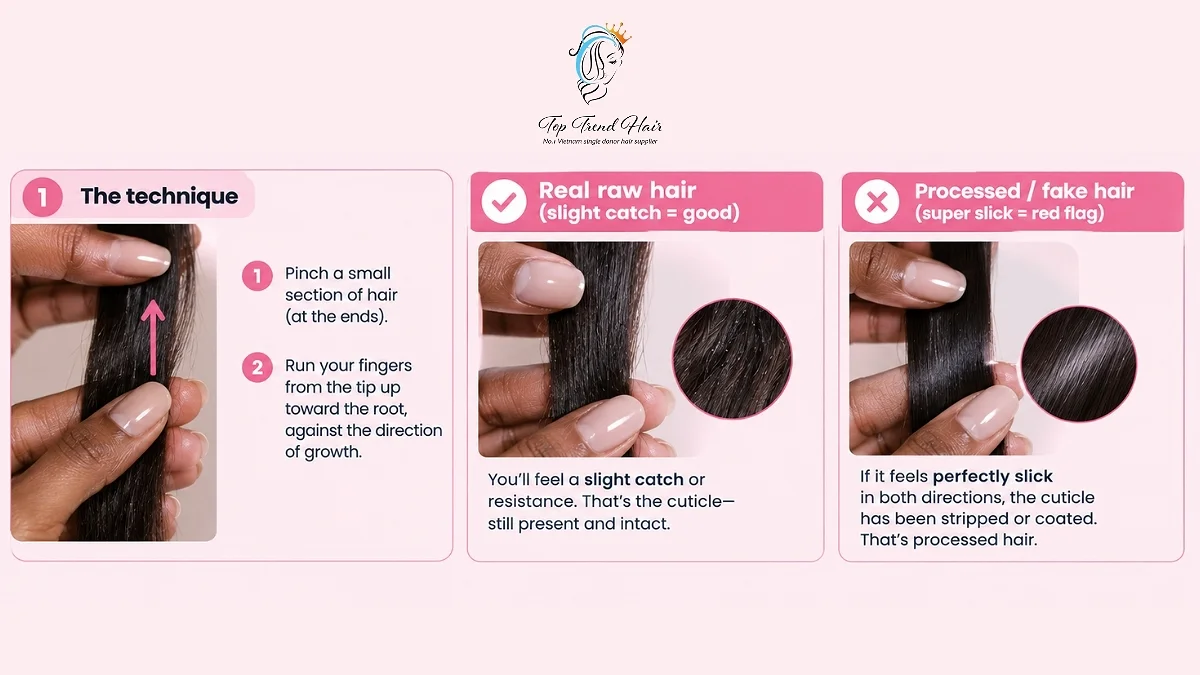
Here’s the technique: pinch a small section and run your fingers from the tip up toward the root, against the direction of growth.
If you feel a slight catch or resistance, that’s the cuticle—still present and intact. A good sign.
If it feels perfectly slick in both directions, the cuticle has been stripped or coated. That’s processed hair.
The touch test is fast, free, and shockingly reliable once you’ve felt the difference a few times. Real raw hair has character under your fingers; fakes feel like plastic pretending.
Test 3: The Bleach Test (The Most Accurate of All)
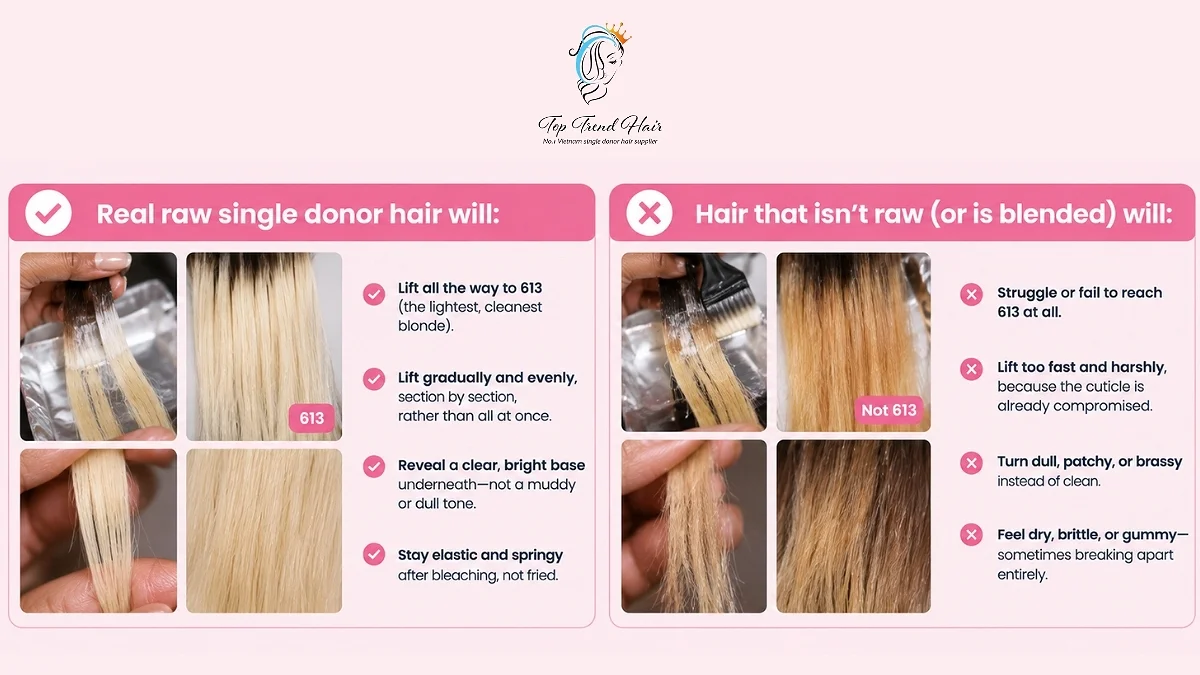
If you only run one test, make it this one. Bleaching is the single most revealing thing you can do to a strand of hair, because color-lifting exposes everything the cuticle is hiding.
You don’t need to bleach a whole bundle—take a tiny section, just 10 to 20 strands, and lift it with developer while you watch how it behaves.
Real raw single donor hair will:
- Lift all the way to 613 (the lightest, cleanest blonde)
- Lift gradually and evenly, section by section, rather than all at once
- Reveal a clear, bright base underneath—not a muddy or dull tone
- Stay elastic and springy after bleaching, not fried
Hair that isn’t raw (or is blended) will:
- Struggle or fail to reach 613 at all
- Lift too fast and harshly, because the cuticle is already compromised
- Turn dull, patchy, or brassy instead of clean
- Feel dry, brittle, or gummy—sometimes breaking apart entirely
That ability to bleach to a true 613 while staying healthy is the hallmark of strong, unprocessed hair, and it’s the exact quality that makes raw Vietnamese hair so prized for color work. A quick safety note: bleaching is a chemical process, so run the test in a ventilated space, protect your skin, and if you’re not confident with developer, have a professional do the sample for you.
Test 4: The Cuticle Scrape Test
The final check confirms, once and for all, whether hair has been chemically processed—and it’s beautifully simple.
Take a single strand and gently scrape along it with your fingernail or the back of a small blade, from tip toward root, shaving off a tiny bit of the outer layer. Then look at what comes off.
- Unprocessed hair produces a white cuticle. Clean, pale shavings mean the outer layer is natural and undamaged—this is raw or virgin hair.
- Chemically processed hair produces brown or black residue. If the shavings carry dark color, the strand has been dyed or chemically treated, and the “raw” label is false.
There’s a bonus insight hidden in this test: the color you scrape off predicts the color the hair will bleach to. Scrape out white, and that hair will lift cleanly to 613 or 60. Scrape out something darker, and you can expect a muddier, harder-to-control result. In other words, the scrape test quietly previews the bleach test—two confirmations from one quick check.
Test 5: The Shedding & Tangling Test
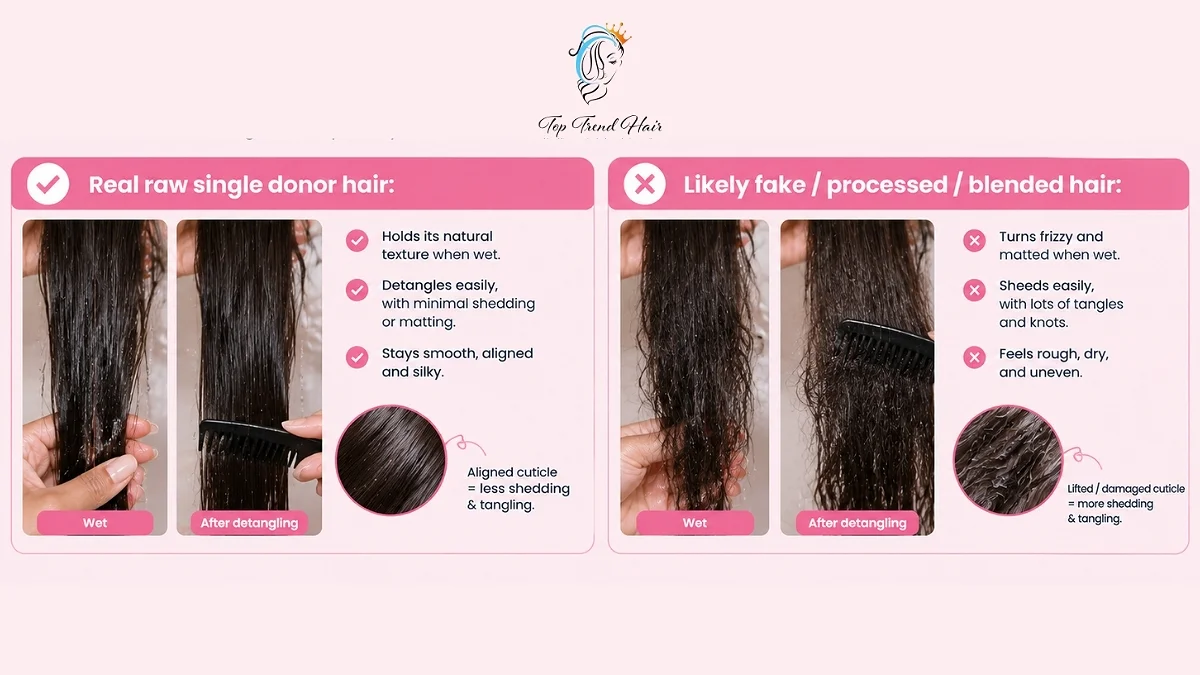
The whole reason raw single donor hair is worth its price is that its aligned cuticle keeps the hair from shedding and matting. This test checks the exact quality vendors fake when they blend cheaper floor hair into a “raw” bundle—and it’s the failure customers complain about most.
Wet the section: genuine raw hair holds its texture and detangles easily, while coated or blended hair turns frizzy and tangles the moment the silicone rinses out. Running this before a bulk order tells you whether the hair will survive real-world washing—or fall apart in your customer’s hands.
Red Flags When Choosing a Raw Hair Vendor
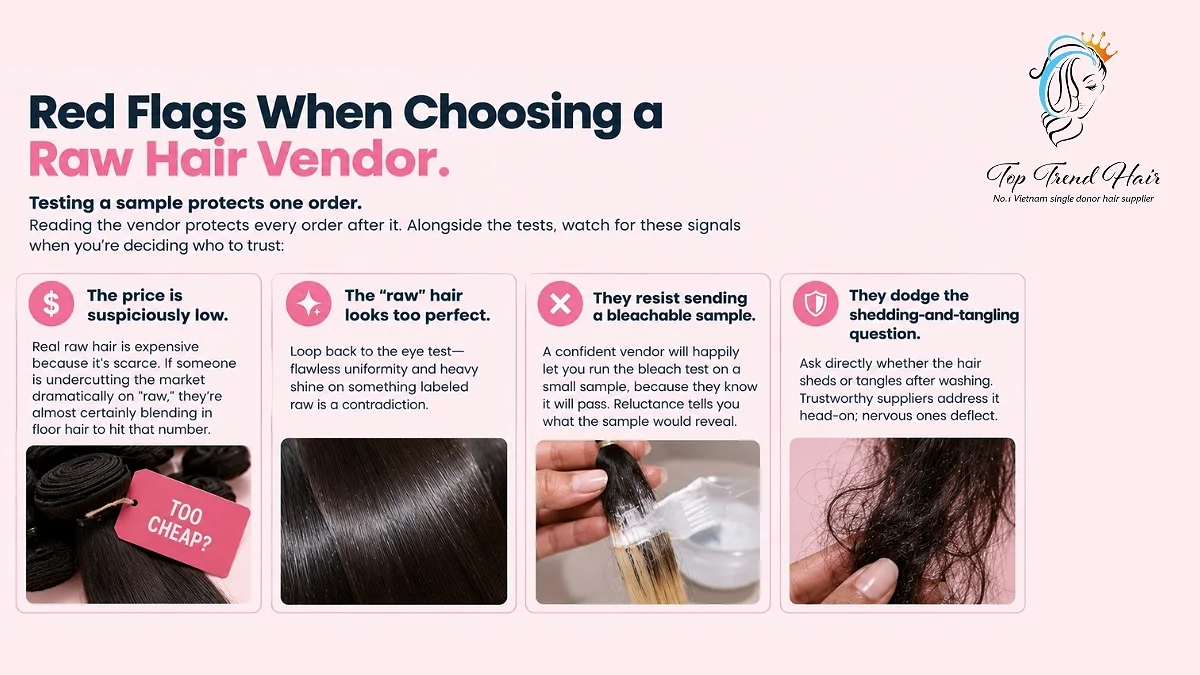
Testing a sample protects one order.
Reading the vendor protects every order after it. Alongside the tests, watch for these signals when you’re deciding who to trust:
The price is suspiciously low.
Real raw hair is expensive because it’s scarce. If someone is undercutting the market dramatically on “raw,” they’re almost certainly blending in floor hair to hit that number.
The “raw” hair looks too perfect.
Loop back to the eye test—flawless uniformity and heavy shine on something labeled raw is a contradiction.
They resist sending a bleachable sample. A confident vendor will happily let you run the bleach test on a small sample, because they know it will pass. Reluctance tells you what the sample would reveal.
They dodge the shedding-and-tangling question.
Ask directly whether the hair sheds or tangles after washing. Trustworthy suppliers address it head-on; nervous ones deflect.
Why Real Raw Single Donor Hair Is Worth the Extra
Once you’ve handled genuine raw single donor hair, the premium makes sense:
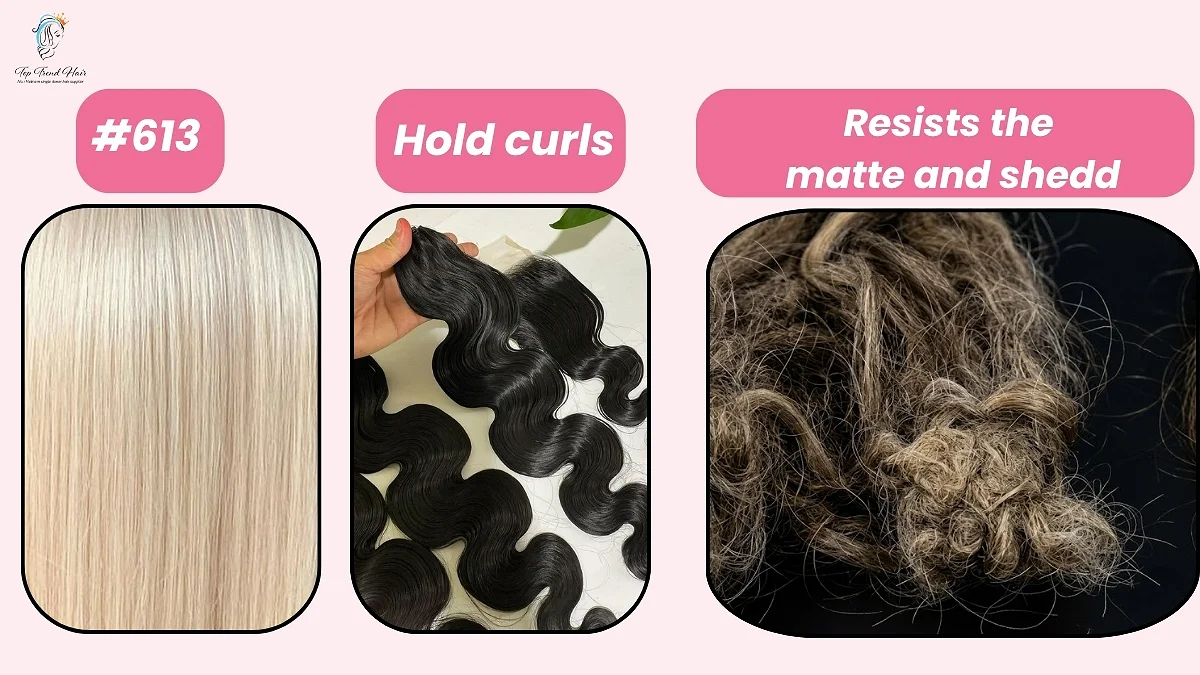
Bleaches to the brightest blondes (a true 613) without falling apart
Holds color and curl through repeat styling and coloring
Resists the matting and shedding that plague cheaper, blended hair
Lasts for years across multiple installs, not just months
For a business, that adds up to fewer complaints, fewer returns, and customers who come back—worth far more than the few dollars saved on a blended bundle.
If you’d rather skip the guesswork entirely, sourcing from a supplier that specializes in one grade helps. Our raw single donor hair is built to pass every test above—cut directly from donors, never chemically processed, and able to lift to a true 613—and we’re happy to send a sample so you can run the bleach test yourself before you commit. For buyers new to sourcing overseas, this walkthrough on how to buy hair from Vietnam covers the ordering process end to end.
Frequently Asked Questions
-
What is raw hair?
Raw hair is human hair cut directly from a single donor that has never been chemically processed. The cuticle stays intact and all strands run the same direction, which is why it resists tangling and lasts far longer than processed or blended hair.
-
How can I test raw hair at home?
Use the five tests in order: check for uneven natural color (eye test), feel for a slightly dry, non-slippery texture (touch test), bleach a tiny section to see if it lifts cleanly to 613 (bleach test), scrape a strand to check for a white cuticle (scrape test), and run your fingers through a section to check it doesn’t shed or tangle (shedding test).
The Bottom Line
You can’t tell real raw hair from a photo, a price tag, or a vendor’s promise—but you can tell with your hands. Run the eye test to filter the obvious fakes, the touch test to feel for an intact cuticle, the bleach test to confirm it lifts clean to 613, the scrape test to prove it was never chemically treated, and the shedding test to make sure it won’t fall apart after a wash. Five quick checks stand between you and an expensive mistake. Do them every time, and let any vendor worth your business prove the hair is exactly what they say it is.
Get a sample that passes all five tests in your own hands, cut directly from donors and never chemically processed, without risking a bulk order on a promise.

